You know that tiny moment of confidence when a pattern says “buy 4 skeins” and your brain says, “Sure, sounds legal”? Then three weeks later you’re playing yarn chicken with twelve rows left and one sad little yarn tail looking back at you like it has rent due.
That’s why yardage matters.
Figuring out how much yarn you need isn’t about memorizing one perfect chart. It’s about looking at the project, the yarn, the size, the stitch pattern, and your gauge before you commit your budget, your time, and your emotional stability to a basket full of skeins.
This guide walks through the practical stuff that changes yarn amount, gives you starting ranges, and shows when to use the Knotledge yarn yardage estimator for a quicker answer.
Quick answer: how much yarn do I need?
For most knitting and crochet projects, yarn amount depends on five things:
- Project type — a hat, scarf, sweater, blanket, and shawl all eat yarn differently.
- Finished size — adult sizes, longer scarves, and larger blankets need more yardage.
- Yarn weight — bulky yarn uses fewer yards than fingering weight, but each yard covers fabric differently.
- Gauge — tighter stitches usually use more yarn than looser stitches.
- Stitch pattern — cables, bobbles, ribbing, dense crochet stitches, and textured fabric can use extra yardage.
If you want a fast starting point, use the yarn yardage estimator. If you want to understand why the number changes, keep reading.
Why yarn yardage gets weird so fast
Yardage looks simple until you put two real projects next to each other.
A worsted-weight garter stitch scarf and a worsted-weight cable scarf could be the same length and width, but the cable scarf can use noticeably more yarn. A loose crochet mesh top and a dense single-crochet bag might both say “DK yarn,” but they won’t behave like the same creature.
Yarn math gets weird because we aren’t just measuring yarn. We’re measuring fabric.
A few details quietly change everything:
- Denser fabric uses more yarn. Tight gauge, firm crochet stitches, cables, and heavy texture all add up.
- Open fabric uses less yarn. Lace, mesh, drop stitches, and airy shawls usually need less.
- Crochet often uses more yarn than knitting. Not always, but dense crochet stitches can be hungry little goblins.
- Garments need extra caution. Sleeves, body length, bust size, ease, and swatching all matter.
- Blankets are yarn vacuums. Cozy, beautiful, and absolutely committed to eating the stash.
So if a chart gives you a number, treat it as a starting estimate, not a sacred prophecy.
Beginner yardage ranges by project type
These ranges are intentionally broad. They’re for planning, not replacing your pattern.
| Project | Common yarn range | Notes |
|---|---|---|
| Adult hat | 150–250 yards | Bulky hats can use less; slouchy hats need more. |
| Cowl | 150–400 yards | Depends heavily on height, circumference, and stitch pattern. |
| Scarf | 350–800 yards | Long, wide, textured scarves climb fast. |
| Shawl | 400–1,200 yards | Lace shawls vary wildly by shape and depth. |
| Baby blanket | 900–1,500 yards | Crochet blankets often sit toward the higher end. |
| Throw blanket | 1,500–3,000+ yards | Size and stitch density matter a lot. |
| Adult sweater | 1,000–2,500+ yards | Size, yarn weight, sleeve length, and fit all change the total. |
| Socks | 350–450 yards | Most adult socks use one standard skein of sock yarn. |
The pattern is still the boss. If you’re using a paid or free pattern with a yardage requirement, start there first. Then adjust if your size, gauge, yarn, or planned modifications differ.
How yarn weight changes yardage
Yarn weight changes how many yards you need because thinner yarn has more yards per skein and creates fabric at a different scale.
A bulky yarn sweater might list fewer total yards than a fingering-weight sweater, but that doesn’t mean the bulky project is “smaller.” It means each bulky stitch covers more space.
Here’s the practical version:
- Fingering and sport weight projects usually need higher yardage numbers.
- DK and worsted weight sit in the friendly middle for many garments and accessories.
- Bulky and super bulky projects often need fewer yards, but each skein can have very low yardage.
That last part matters. A super bulky skein might look enormous and still only have 80 yards. Rude, but common.
If the yarn label uses a weight name you’re unsure about, check the yarn weight converter or read the yarn weights guide before buying.
The ball band isn’t enough
The yarn label can tell you useful things: yardage, weight, fiber content, suggested needle or hook size, and gauge. It can’t tell you the whole story of your project.
The ball band gauge is usually measured in plain stockinette or a basic stitch. Your pattern could use lace, cables, moss stitch, granny clusters, ribbing, or something that looks innocent until it starts consuming yarn like it has a tiny spoon.
Use the label for:
- total yards per skein
- fiber content
- yarn weight category
- suggested tool size
- a rough gauge starting point
Use your pattern and swatch for:
- actual stitch gauge
- fabric feel
- drape
- stitch density
- whether you need more yarn than the label implies
This is also why two makers can use the same yarn and pattern but finish with different leftovers. Your hands are part of the math. Annoying, but also kind of charming.
When to buy extra yarn
If you’re between amounts, buy the extra skein when you can. Future You deserves fewer problems.
Extra yarn is especially smart when:
- you’re making a garment
- you’re between sizes
- you’re adding length
- you’re using cables, bobbles, ribbing, or dense crochet stitches
- your gauge is tighter than the pattern gauge
- the yarn is hand-dyed or has dye lots
- the yarn is discontinued, seasonal, or hard to find locally
A good rule: add 10–15% extra yardage for most projects when you’re unsure. For larger garments, heavy texture, or serious modifications, 15–20% extra can be safer.
If you’re working with hand-dyed yarn, buy enough at once and alternate skeins where needed. Dye lots and hand-dyed variation can turn “I’ll just order one more later” into a small textile mystery novel.
How to estimate yarn before you buy
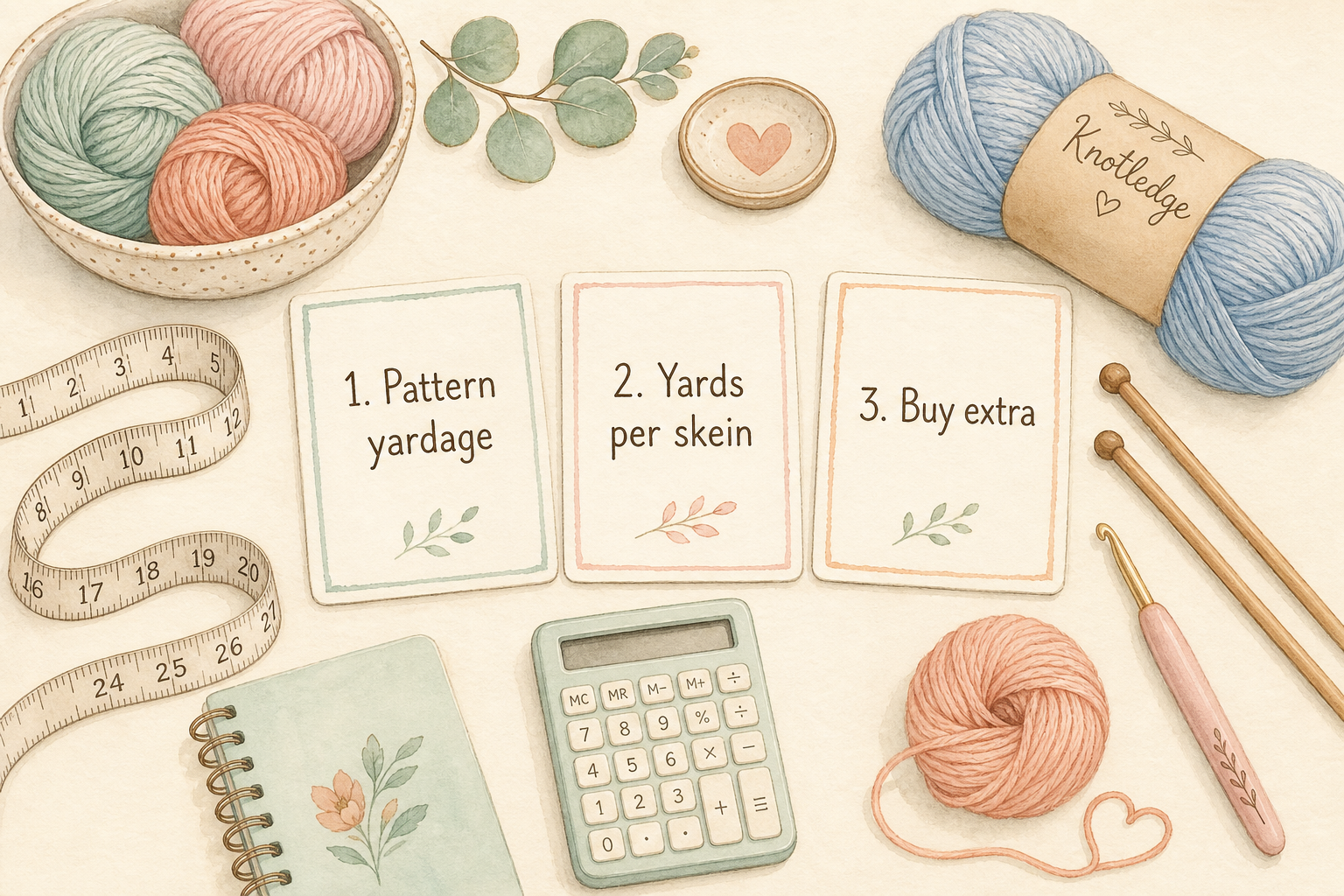
Here’s the calm version of the workflow.
1. Start with the pattern yardage
If you have a pattern, use its yardage for your size. Check whether the number includes all sizes or just the sample size. Pattern pages can hide that detail in the tiny print because apparently we enjoy quests.
2. Match the yarn weight
Stay close to the recommended yarn weight unless you already plan to rewrite the fabric. Switching from DK to worsted or worsted to bulky changes more than yardage. It changes gauge, drape, size, and sometimes the whole mood of the project.
If you’re substituting yarn, the yarn substitution guide can help you compare weight, fiber, and grist before committing.
3. Check yards per skein, not just skein count
“Skein” isn’t a standard unit of usefulness. One worsted skein might have 100 yards; another might have 220 yards. Always compare total yardage.
Use this simple formula:
total yards needed ÷ yards per skein = number of skeins to buy
Then round up. Always round up. Yarn doesn’t care about decimals.
Example: if your project needs 875 yards and each skein has 210 yards:
875 ÷ 210 = 4.17
You’d buy 5 skeins.
4. Swatch if size matters
For scarves and dishcloths, you can be a little loose with planning. For sweaters, fitted accessories, and anything where size matters, swatch first.
If your gauge has more stitches per inch than the pattern, your fabric is tighter and could use more yarn. If your gauge has fewer stitches per inch, the project could grow bigger than planned. Either way, it deserves a check before you buy sweater quantities.
5. Use the estimator for a starting range
When you don’t have a pattern yet, use the Knotledge yarn yardage estimator to get a starting range by project type, craft, size, and yarn weight.
It’s especially useful when you’re planning from stash, comparing project ideas, or trying to decide whether those three beautiful skeins are enough for anything besides sitting in a basket and looking expensive.
Yardage examples
Let’s make this less abstract.
Example 1: one-skein worsted hat
You have one 100g skein of worsted yarn with 220 yards. For a simple adult hat, that’s usually enough. If the hat is very slouchy, heavily cabled, or folded-brim, you might want a second skein or a contrast color for insurance.
Example 2: DK baby blanket
A small DK baby blanket could land around 1,000–1,400 yards depending on stitch pattern and dimensions. A simple open stitch might sit near the lower end. Dense crochet or heavy texture could push it higher.
Example 3: fingering-weight sweater
A fingering-weight adult sweater can easily need 1,400–2,200+ yards depending on size and fit. If you’re adding length or choosing a textured stitch, build in extra. Sleeves have a way of pretending they’ll be quick and then becoming a whole subplot.
Quick yarn-buying checklist
Before you buy yarn for a project, check:
- the pattern yardage for your actual size
- yards per skein or ball
- yarn weight and fiber content
- whether your stitch pattern is dense or open
- whether you’re changing length, sleeves, width, or fit
- dye lot or hand-dyed variation
- whether the yarn will still be available if you run short
If the project is important, buy extra. If the yarn is rare, buy extra. If the project is a gift and the deadline is already doing little jump scares in your calendar, absolutely buy extra.
The cozy answer
Yardage estimates are there to keep you from guessing in the yarn aisle with vibes as your only spreadsheet.
Start with the pattern when you have one. Check total yards, not skein count. Add a little cushion when size, texture, or dye lots matter. And when you’re planning without a pattern, use the Knotledge yarn yardage estimator to get a practical starting range before you buy.
Less yarn chicken. More making.
Related tools: Yarn Yardage Estimator · Yarn Weight Converter
Related reading: Understanding Yarn Weights · How to Substitute Yarn

Continue exploring with
Yarn Yardage Estimator →