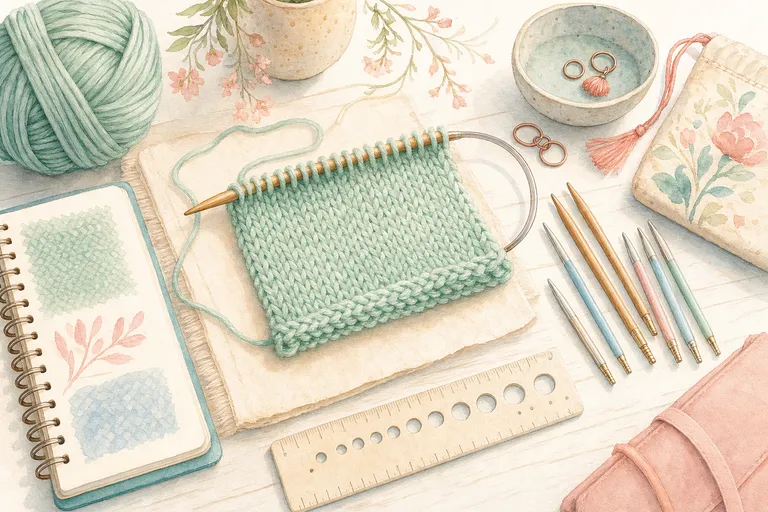
Choosing the right needle size is not just matching the yarn label. The best needle is the one that gives you the gauge, drape, and fabric your project needs.
If you’re wondering how to choose knitting needle size, start with three things: the pattern gauge, the yarn weight, and the fabric you want in your hands. The number printed on the needle is a starting point — your swatch is the answer.
Quick Answer: How to Choose Knitting Needle Size
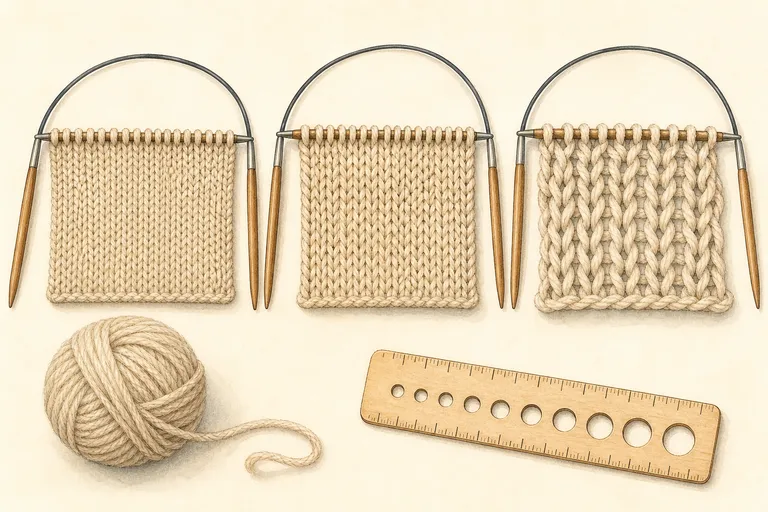
Use the needle size recommended in your pattern or on your yarn label as a starting point. Knit a gauge swatch. If you have too many stitches per inch, your stitches are too small, so go up a needle size. If you have too few stitches per inch, your stitches are too large, so go down a needle size.
For projects where exact size matters, like sweaters, socks, hats, and fitted mitts, gauge matters more than the suggested needle size. For scarves, shawls, blankets, and other flexible projects, the feel of the fabric can matter just as much.
Needle Size and Gauge: The Rule That Matters Most
Gauge is how many stitches and rows fit into a measured area, usually 4 inches or 10 cm. Needle size and gauge are linked, but they aren’t identical from knitter to knitter.
Two knitters can use the same yarn and the same needles and still get different results. One might knit tightly, one might knit loosely, and both can be doing perfectly normal knitting.
Use this simple adjustment rule:
| Your swatch result | What it means | What to try next |
|---|---|---|
| Too many stitches per inch | Your gauge is too tight | Go up one needle size |
| Too few stitches per inch | Your gauge is too loose | Go down one needle size |
| Correct stitch gauge, wrong row gauge | Usually okay unless length shaping depends on rows | Adjust length by measuring as you knit |
| Gauge matches, fabric feels stiff | Size may be technically right but not pleasant | Try going up and check finished measurements |
| Fabric feels too loose or holey | Needle may be too large for the yarn or project | Try going down |
A cozy note: don’t judge the swatch while it’s still fresh off the needles. Wash or block it the way you plan to treat the finished project. Yarn can bloom, relax, stretch, or tighten after washing.
If the fabric feels wrong, the needle number is not the boss of you. Adjust and swatch again.
Start with Yarn Weight, Then Decide by Fabric
A yarn label usually gives a suggested needle range. That range is helpful, but it’s not a promise. The same DK yarn can become a tidy cardigan fabric on smaller needles or a breezy shawl fabric on larger ones.
Here’s a practical knitting needle size chart for common starting points:
| Yarn weight | Common starting needle range | Good for |
|---|---|---|
| Lace | 1.5–2.75 mm / US 000–2 | Fine lace, airy shawls |
| Fingering / sock | 2.25–3.25 mm / US 1–3 | Socks, lightweight sweaters, baby knits |
| Sport | 3.25–3.75 mm / US 3–5 | Light garments, accessories |
| DK | 3.75–4.5 mm / US 5–7 | Sweaters, hats, mitts, baby blankets |
| Worsted / aran | 4.5–5.5 mm / US 7–9 | Everyday sweaters, scarves, blankets |
| Bulky | 5.5–8 mm / US 9–11 | Fast hats, cowls, chunky cardigans |
| Super bulky | 8–12.75 mm / US 11–17 | Statement scarves, big blankets |
This chart is a starting place, not a final answer. If your project has a published pattern, follow the pattern gauge first. If you’re making your own plan, choose the fabric you want: firm, balanced, or drapey.
What Size Needles for DK Yarn?
For DK yarn, a common starting point is 4 mm / US 6 needles. Lots of DK projects fall between 3.75 mm and 4.5 mm, or US 5 to US 7.
Choose within that range based on the project:
- Use smaller DK needles, around 3.75 mm / US 5, for firmer fabric, colorwork, mitts, and children’s garments.
- Use 4 mm / US 6 for a balanced sweater or hat fabric.
- Use larger DK needles, around 4.5 mm / US 7, for softer drape, looser scarves, or relaxed shawls.
If a DK sweater pattern says 22 stitches over 4 inches and your swatch has 24 stitches, go up a needle size. If your swatch has 20 stitches, go down a needle size.
Knitting Needle Sizes Explained
Knitting needle sizes can be listed in millimeters, US sizes, UK/Canadian sizes, or Japanese sizes. Millimeters are the clearest because they describe the actual diameter of the needle.
A 4 mm needle is 4 mm no matter where you bought it. A “US 6” or “UK 8” depends on the sizing system, which is why conversions get confusing quickly.
When you need to translate between systems, use the Hook & Needle Converter. This article is here to help you decide which size to try; the converter is the best place to check the exact US, UK, metric, or Japanese equivalent.
When to Go Up a Needle Size
Going up a needle size makes stitches larger and the fabric more open. It can be the right move when:
- Your swatch has too many stitches per inch.
- The fabric feels stiff, dense, or board-like.
- You want more drape in a scarf, shawl, or loose cardigan.
- Your yarn is very grippy, fuzzy, or rustic and needs room to bloom.
- Your finished piece is coming out smaller than expected.
Be careful going up for fitted garments. A half stitch per inch can add several inches around a sweater. Pretty drape is lovely; accidental tent sweater is less lovely.
When to Go Down a Needle Size
Going down a needle size makes stitches smaller and the fabric firmer. It can help when:
- Your swatch has too few stitches per inch.
- The fabric looks loose, uneven, or see-through.
- You’re knitting socks, mittens, bags, or anything that needs durability.
- Your yarn is slippery or heavy and could stretch with wear.
- Your colorwork motifs look blurry and need a tidier fabric.
Socks are the classic example. Even if the yarn label suggests a larger needle, sock knitters often use small needles to create dense fabric that holds up inside shoes.
Match Needle Size to Project Type
Different projects ask for different fabric. The “right” needle for a DK shawl might be wrong for DK mittens.
Sweaters and cardigans: Match the pattern gauge. Drape matters, but finished measurements matter more. Swatch generously and block before committing.
Socks: Choose a firm gauge. Smaller needles help the fabric resist wear and keep its shape.
Hats: Aim for fabric that is warm but stretchy. If the brim feels loose, go down for the ribbing or use a smaller needle just for the brim.
Shawls and scarves: You have more freedom. Larger needles can make the fabric soft, airy, and fluid.
Blankets: Think about warmth, durability, and weight. Very loose blanket fabric can stretch over time, especially with cotton or superwash wool.
Colorwork: Many knitters need to go up a needle size for stranded colorwork because floats reduce stretch. Swatch in the actual colorwork pattern, not just plain stockinette.
Fiber Changes the Decision
Yarn weight tells you thickness. Fiber tells you behavior.
- Wool has bounce and forgiveness. It usually works well across a range of needle sizes.
- Superwash wool can grow after washing, so block your swatch and treat large needles with caution.
- Cotton has less elasticity and can feel heavy. A slightly firmer gauge often helps it keep shape.
- Linen might feel stiff while knitting but softens with washing and wear.
- Alpaca is warm and drapey, but it can stretch. Avoid going too loose for garments.
- Silk and bamboo blends are smooth and fluid. They can make beautiful drape, but fitted pieces might need a firmer gauge.
If your yarn is slippery, wood or bamboo needles can give you more control. If your yarn is sticky or rustic, metal needles can help the stitches move more easily.
Needle Material and Type Matter Too
Needle size affects gauge, but needle material affects how your stitches behave while you knit.
Wood and bamboo: Warm, grippy, and beginner-friendly. Helpful for slick yarns or lace stitches that like to wander.
Metal: Smooth and fast. Great for wool, tight knitting, and projects where you want stitches to glide.
Plastic or resin: Lightweight and flexible, especially in larger sizes.
Needle type matters too:
- Straight needles work for flat pieces, but the project weight sits on your wrists.
- Circular needles work for knitting in the round and flat knitting. They’re often more comfortable for sweaters and blankets because the cable carries the weight.
- Double-pointed needles are useful for socks, sleeves, mittens, and other small tubes.
- Long circulars can replace DPNs for magic loop knitting.
A Simple Needle-Choosing Workflow
Use this when you are starting a new project:
- Check the pattern’s recommended needle and gauge.
- Check the yarn label’s suggested needle range.
- Pick a starting needle that fits both, if possible.
- Knit a swatch in the stitch pattern the project uses.
- Wash or block the swatch.
- Measure stitch gauge first, then row gauge.
- Go up or down a needle size if needed.
- Decide whether the fabric feels right for the project.
If you’re changing gauge on purpose, use the Project Size Converter to understand how a different gauge affects finished measurements.
FAQ
What is the best knitting needle size for beginners?
Many beginners like worsted-weight yarn with 5 mm / US 8 needles. The yarn is easy to see, the needles are comfortable to hold, and the stitches are not so tiny that progress feels slow.
Should I use the needle size on the yarn label or the pattern?
Use the pattern as your first guide, especially for garments and fitted accessories. The yarn label gives a general range, but the pattern tells you the gauge needed for that specific design.
Does a bigger needle use more yarn?
Usually, a bigger needle creates larger stitches and a looser fabric. The total yarn use depends on the finished size, stitch pattern, and gauge. If the bigger needle makes the project larger, it might use more yarn.
Can I change needle size instead of changing yarn?
Sometimes. You can adjust gauge a little with needle size, but you can’t turn fingering yarn into bulky yarn just by using huge needles. If the fabric becomes too loose or stiff, choose a different yarn weight instead.
How do I convert US needle sizes to metric?
Use the Hook & Needle Converter for accurate conversions. Metric millimeters are the most reliable reference when comparing knitting needle sizes.
The Takeaway
The right knitting needle size is the one that gives you the fabric your project needs. Start with the pattern and yarn label, swatch honestly, adjust for gauge, and pay attention to drape.
Needle sizes are numbers. Your swatch is information. Trust the fabric in your hands.
Continue exploring with
Hook Needle Converter →