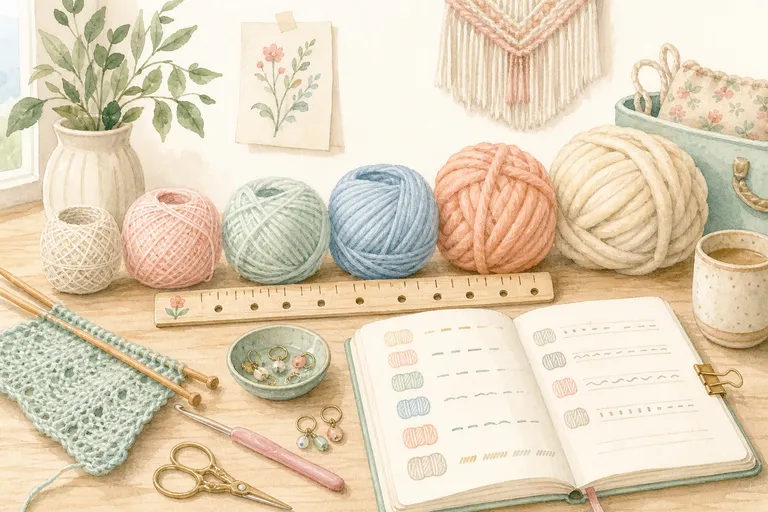
Yarn weight is the thickness of your yarn. Not the heaviness of the skein, not how luxurious it feels when you squish it in the yarn aisle, and not how persuasive the colorway is being. Just thickness.
That one detail changes almost everything: gauge, drape, yardage, hook size, project size, fabric density, and whether your “quick hat” becomes a placemat with opinions.
Use this yarn weight chart as a practical reference when you are reading a pattern, substituting yarn, sorting mystery stash, or trying to make two not-quite-identical skeins behave like they are on speaking terms.
Yarn weight chart
The Craft Yarn Council system uses numbers 0 through 7, from lace to jumbo. Labels are helpful, but they are not law. Different brands can sit at the thin or thick edge of a category, so treat the chart as a starting point and let gauge have the final word.
| CYC weight | Common names | Typical WPI | Common crochet hook range | Good for |
|---|---|---|---|---|
| 0 | Lace, thread, light fingering | 33+ | Steel hooks or 1.4–2.25 mm | Shawls, fine lace, delicate details |
| 1 | Super fine, fingering, sock, baby | 27–32 | 2.25–3.5 mm | Socks, lightweight garments, baby items |
| 2 | Fine, sport, baby | 23–26 | 3.5–4.5 mm | Lightweight sweaters, accessories, soft baby projects |
| 3 | Light, DK, light worsted | 18–22 | 4.5–5.5 mm | Garments, scarves, hats, everyday crochet |
| 4 | Medium, worsted, aran, afghan | 14–17 | 5.5–6.5 mm | Blankets, hats, amigurumi, home goods |
| 5 | Bulky, chunky, rug | 10–13 | 6.5–9 mm | Fast scarves, warm hats, cushy blankets |
| 6 | Super bulky, super chunky, roving | 6–9 | 9–15 mm | Quick blankets, oversized accessories, statement pieces |
| 7 | Jumbo, roving | 5 or fewer | 15 mm and larger | Arm crochet, giant baskets, dramatic texture |
How to use a yarn weight chart without overthinking it
Start with the pattern’s listed yarn weight, then compare the yarn label, recommended hook size, yardage per skein, and gauge. If all four are in the same neighborhood, you are probably safe to swatch.
A useful order of operations:
- Match the weight category first. If the pattern uses DK, look at DK or light worsted before wandering into bulky territory.
- Compare fiber content. Cotton, wool, acrylic, alpaca, and plant blends can all behave differently at the same weight.
- Check yardage per 100 grams. A very airy worsted and a dense worsted may both say “4,” but they will not necessarily make the same fabric.
- Make a gauge swatch. Yes, really. Future You deserves this small mercy.
If you need to translate between terms like DK, worsted, aran, sport, and bulky, use the Yarn Weight Converter. It is especially helpful when a pattern uses a naming system from another country or an older yarn label uses language that feels more poetic than precise.
Yarn weights explained in plain terms
Think of yarn weight as the size of the strand. Thin yarns make lighter, finer fabric with more stitches per inch. Thick yarns make bigger stitches, denser texture, and faster progress.
That does not mean thicker is always easier. Bulky and super bulky yarns work up quickly, but they can also create stiff seams, heavy garments, and blankets that require their own weather system. Lace and fingering yarns take longer, but they shine when you want drape, detail, or a wearable fabric that doesn’t feel like upholstery.
Here is the practical version:
- Lace and fingering are for light, detailed, drapey projects.
- Sport and DK are the flexible middle ground for garments and accessories.
- Worsted is the familiar workhorse for blankets, hats, amigurumi, and home projects.
- Bulky and super bulky are for speed, warmth, and texture.
- Jumbo is for statement projects, not subtlety.
WPI: wraps per inch yarn measurement
Wraps per inch, usually written as WPI, is a simple way to estimate yarn weight when the label is missing or suspicious. It is one of the best tricks for identifying mystery yarn weight from a stash bin.
To measure WPI:
- Wrap the yarn around a ruler for exactly one inch.
- Keep the wraps touching, but do not overlap them.
- Do not stretch the yarn tight. Let it sit naturally.
- Count how many wraps fit in that inch.
- Compare the number to the yarn weight chart above.
If your yarn is fuzzy, textured, chained, thick-and-thin, or generally living its own truth, WPI might be approximate. In that case, use WPI plus a small swatch. The swatch will tell you what the yarn actually does when stitched, which is more useful than what it claims on paper.
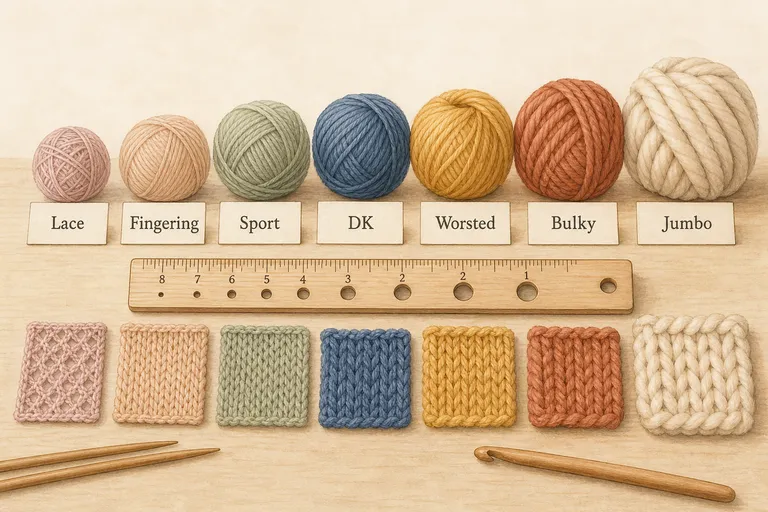
Use WPI as a clue, then let a swatch confirm what the yarn actually wants to be when it grows up.
How to identify mystery yarn weight
Mystery yarn is yarn with no label, an incomplete label, or a label that has clearly been through something. To identify it, gather a few clues instead of relying on one measurement.
Check:
- WPI measurement
- Fiber feel and stretch
- Yardage if you can weigh and estimate it
- How it works up with a likely hook size
- Whether the fabric feels drapey, firm, splitty, fuzzy, or dense
If the yarn lands between two categories, choose based on fabric. A yarn that measures between DK and worsted might behave like DK in a loose shawl and worsted in a tight amigurumi. Yarn is annoying like that, but at least it’s pretty.
For leftover skeins and label-less treasures, the Stash Buster Ideas tool can help you find projects that fit the amount and type of yarn you actually have, instead of the imaginary perfect skein that definitely does not live in your closet.
Yarn weight conversion chart notes
A yarn weight conversion chart helps translate common terms, but names can vary by region and brand. “Worsted” and “aran” are sometimes used interchangeably, but aran is often a little heavier. “Baby yarn” can mean fingering, sport, or DK depending on the brand. “Chunky” and “bulky” usually point to weight 5, but not always with the same thickness.
Use conversions as guidance, then check gauge. If a pattern gives both a weight and a gauge, the gauge matters more.
Quick translation:
| If a pattern says… | Start by looking at… |
|---|---|
| Lace | Weight 0 |
| Fingering, sock, 4-ply | Weight 1 |
| Sport, baby | Weight 2 |
| DK, light worsted, 8-ply | Weight 3 |
| Worsted, aran, afghan, 10-ply | Weight 4 |
| Bulky, chunky, 12-ply | Weight 5 |
| Super bulky, super chunky | Weight 6 |
| Jumbo | Weight 7 |
For a faster lookup, use the Yarn Weight Converter instead of trying to remember whether “8-ply” means DK or something invented to humble you.
Yarn substitution basics
Yarn substitution is possible, but it is not just swapping one pretty skein for another pretty skein and hoping the crochet gods are in a generous mood.
When substituting yarn, compare:
- Weight: Is it the same category or very close?
- Gauge: Can you match the pattern gauge with a fabric you like?
- Fiber: Will it stretch, bloom, shrink, soften, or grow?
- Yardage: Do you have enough total length, not just the same number of skeins?
- Drape: Does the finished fabric move the way the project needs it to?
- Care: Can the finished item be washed the way it will actually be used?
A wool DK and a cotton DK can both be weight 3, but the wool might bounce while the cotton might hang and stretch. That matters in a sweater. It matters less in a dishcloth, because, well…simpler ambitions.
Common substitution risks
Substitution gets risky when the project depends on fit, structure, or a specific fabric behavior.
Be extra careful with:
- Garments, especially fitted sweaters and tops
- Hats, socks, and mittens where size matters
- Bags and baskets that need structure
- Blankets where weight and yardage can spiral quickly
- Amigurumi, where gauge affects stuffing and shape
- Lace patterns that need blocking and drape
If you go up a yarn weight, the project will usually get larger, heavier, and use fewer yards per stitch but more grams overall. If you go down a yarn weight, the project may get smaller, lighter, and require more stitches and more time. Neither is wrong. Both should be done on purpose.
Holding yarn double
Holding two strands together can create a thicker yarn, but it is not a perfect formula. Two fingering strands often behave near DK. Two DK strands may land around bulky. A lace strand held with another yarn can add halo, softness, or color without changing the weight as much as you expect.
Always swatch held-together yarns. The fabric can become denser than a single strand of the same apparent thickness, and yardage math changes because you are using multiple strands at once.
If you are adapting a project and need to estimate whether you have enough yarn, use the Yarn Yardage Estimator. It is built for the moment when “I probably have enough” starts sounding suspicious.
How yarn weight affects yardage
Thinner yarn has more yards per ounce or gram. Thicker yarn has fewer yards per ounce or gram. That is why a 100g skein of fingering might contain 400 yards, while a 100g skein of super bulky might contain 70 yards.
This matters because patterns usually require total yardage, not just skein count. Five skeins of one worsted yarn may not equal five skeins of another worsted yarn. Check the yards or meters on the label, add them up, and give yourself a buffer.
For blankets, oversized garments, and stash projects, the Yarn Yardage Estimator can help you plan before you discover, three rows from the end, that your discontinued yarn has vanished from civilization.
Quick answers
What is the most common yarn weight?
Medium weight yarn, also called worsted or aran, is one of the most common yarn weights. It is often labeled as CYC weight 4 and works well for blankets, hats, scarves, amigurumi, and many beginner projects.
What does yarn weight mean?
Yarn weight means yarn thickness. It affects gauge, hook size, drape, yardage, and finished project size.
How do I know what weight my yarn is?
Check the label first. If the label is missing, measure wraps per inch yarn by wrapping it around a ruler for one inch and counting the wraps. Then compare the count to a yarn weight chart and make a small swatch.
Can I use DK instead of worsted?
Sometimes, but expect a smaller or lighter fabric unless you adjust hook size, stitch count, or gauge. DK is usually weight 3; worsted is usually weight 4. Swatch before substituting, especially for garments or fitted items.
Can I use worsted instead of bulky?
Usually not without changing the pattern. Worsted is thinner than bulky, so the finished item may come out smaller and less dense. You might be able to hold worsted double, but you still need to swatch (I know you don’t think you do, but trust me, you do!)
The practical takeaway
A yarn weight chart gets you into the right neighborhood. Gauge tells you the address.
Use the chart to narrow your options, WPI to identify mystery yarn, and substitution basics to avoid unpleasant surprises. When the math stops mathing, let the Knotledge tools help: start with the Yarn Weight Converter, check yardage with the Yarn Yardage Estimator, and turn leftovers into something useful with Stash Buster Ideas.
Continue exploring with
Yarn Weight Converter →